To support the ‘Bennel Wood – Woodland Laboratory’ project, we’ll be posting a series of blogs as we learn more about natural regeneration and the influence different treatments have on what grows on (and lives in!) a recently felled commercial site.
The eighth blog is by DGW’s McNabb Laurie, looking back at one year of woodland ownership…
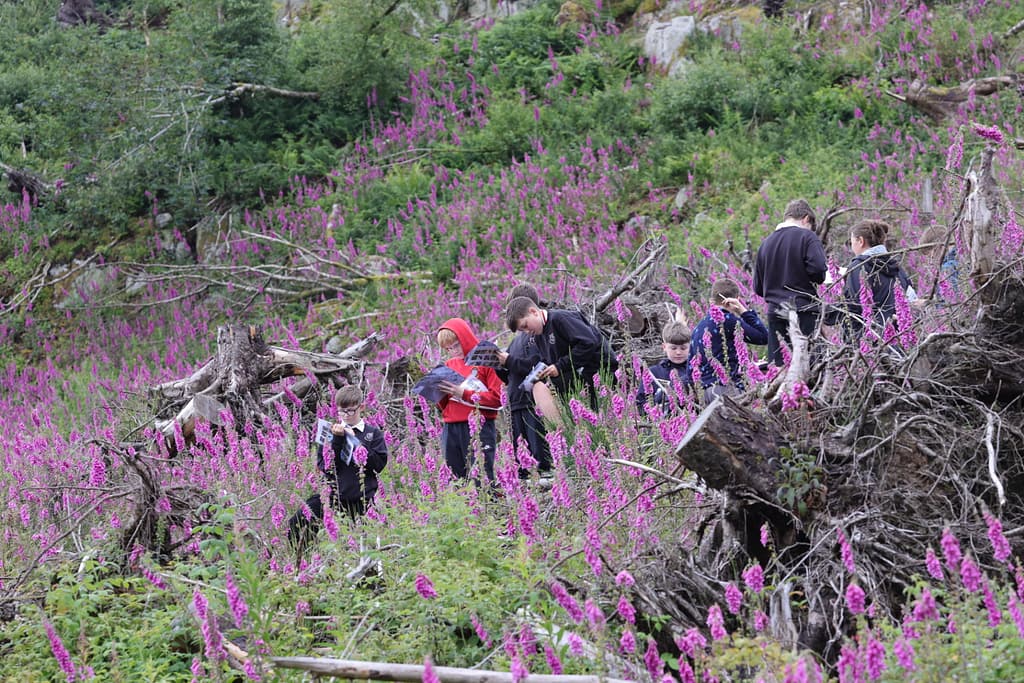
This December is the one-year anniversary of our purchase of Bennel Wood, a recently felled conifer site near Dalbeattie which we are launching as a ‘woodland laboratory’.
Sometimes all I can see are things we haven’t done yet, but it is probably quite an important thing to look back at our first year of activity.
The change underway in the trees and other flora on the site is stark – it feels like Birch needs you only to blink and it can get established. We are now almost two years since site clearance and the ground is covered in wee Downy Birch Trees, usually 10-30cms high. This year has seen a carpet of visitors – foxgloves, raspberry and brambles. Some will return in different proportions next year.

It is the tree growth which is driving the project. We are aiming to explore a range of new treatments on natural regenerating woodland, and try to measure the economic, ecological and social benefits that derive from natural regeneration as a process. Basically, what role can natural regeneration play and what benefits can it deliver.
The precise suite of treatments that we will adopt is developing a slight ‘waking up at night screaming’ quality. It feels there are fewer grains of sand on a beach than there are variables. Everyone we meet on the site or to discuss the opportunities has a different suggestion – varying from ‘do nothing and monitor it’ through to novel products that are either just arriving on the market or even in development.
We have been learning a lot this year about statistical and scientific ‘rigour’. The rule of three dictates any treatments need to be trialled at least three times, and the need for a control area with no intervention means we can quite easily consume the 13-hectare site.
In real life, we are going to be able to ask two or three questions with the treatments adopted. Our ambition is for this management plan to be in place by the second half of 2026. Once the management plan is in place, whenever anyone asks “what are you going to be doing on Bennel”, the reply will be crisp and concise, not the twenty minute transmission of options that people receive currently…
We were so excited to install a pedestrian gate in January 2025 but that has been dwarfed by the arrival firstly of shipping container building from Dalbeattie’s Iron & Pine in April, and establishing new paths in August. It has been great to work with local businesses as we establish ourselves on the site. Local supply chains and economic benefits are a vital part of the story.

If I had to pick the moment of peak stress in the year it was seeing the lorry with the shipping container on it struggling to get up the last 50 metres of road to delivery point. This was not an “anywhere is fine” moment… visibly relived to see the lorry make it to the pre-arranged spot on the second attempt…
We have had a raft of baseline studies done through the year – everything from botany and invertebrates through to soil carbon sampling and mycorrhizal partner surveys. All with a view to getting to know the site but also establishing baseline data.
Hosting our first school and group visits has been a learning process as well – it will be a relief (!) to future visitors that we also have a rather smart new compost loo…
It is really exciting to think Bennel wood could be plugged into the research matrix. We have made friends as far afield as University of Birmingham and the University of Edinburgh. Again, this feeds into our management plan discussions, but amazing if what we do at Bennel contributes to national research strands.
And then in October the more operational context of being a woodland owner hits, with a large Beech tree blown down in a storm into a neighbour’s field. We downed all tools to…pick up other tools… and focus on getting it cleared.

If you strip all the ‘woodland laboratory’ ness out of the project, we are now a woodland owner. It is questionable whether anyone can ever ‘own’ a woodland, rather than simply be a short-term custodian set against a longer timeline, but this first year has shown us how you balance ambitions with the practicalities of woodland ownership. We have learned so much, from legalities to Rhododendron control. Owning Bennel Wood has already improved the support we are offering other woodland owners across the region.
As we look at our first year, for Bennel Woodland Laboratory as a whole, the journey has barely begun. If a week is a long time in politics, a year is no time in a woodland.
I can’t not end by saying THANK you to just everyone involved. Too many to list but if you have visited or played a part in Bennel Wood’s year, we are incredibly grateful…
McNabb Laurie – December 2025