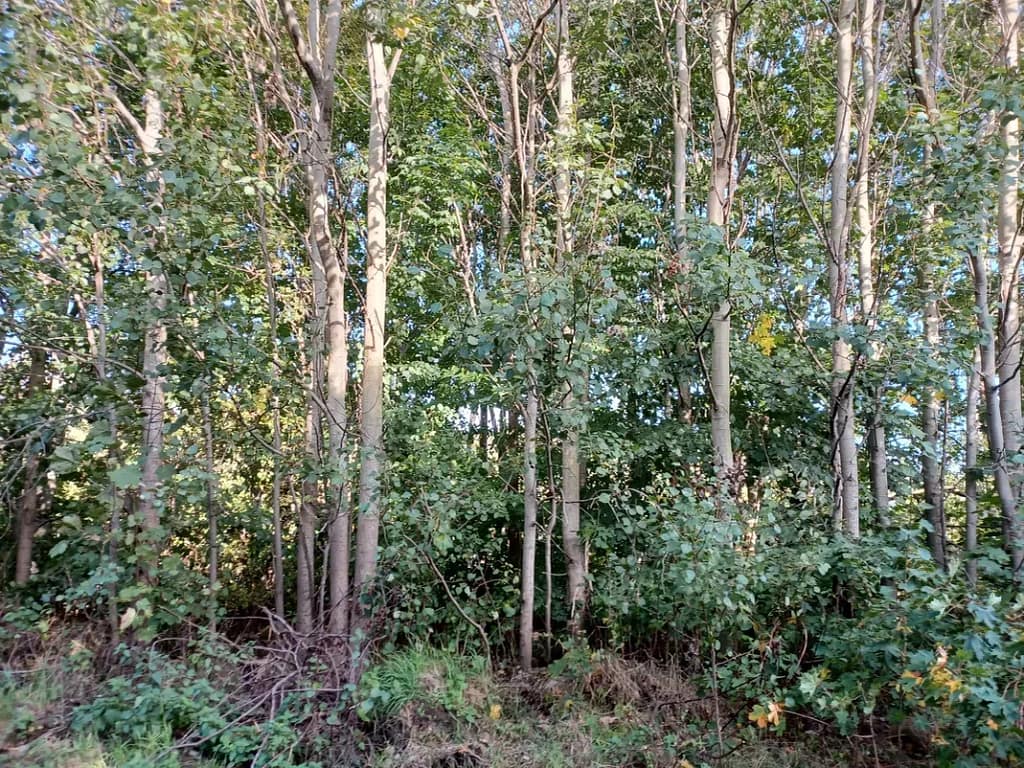
The Solway Coast & Marine Landscape Connections Project (SCAMP) is a chance for us to better understand and then protect and support our Coastal Woodlands. Work is underway to identify coastal woodland species in our region – and it is already clear that Aspen (Populus tremula) is a species largely absent from the mix. How can we plant the next generation of locally-sourced Aspen?
Dumfries & Galloway Woodlands (DGW) is excited to be working to fulfil The Solway Coast & Marine Project (SCAMP) ambitions to protect and support our coastal woodlands. Aspen plays a vital role in the D&G landscape – from craggy coastal outcrops to sites inland. Many of the clones used in Scotland’s clone bank were gathered from coastal locations in Dumfries & Galloway, our region’s Aspen form a vital part of Scotland’s Aspen recovery efforts!
SCAMP and DGW are working together to host the brilliant Peter Livingstone from Eadha Enterprises (www.eadha.co.uk) for an event that has one clear aim – how to source and then propagate local Aspen.
Aspen rarely sets seed. It requires a long dry summer in the previous year which rarely occurs now! However Aspen also multiplies by vegetative means, sending out root suckers which then grow to form new trees. These suckers can multiply themselves in the same way so that a single tree can become a large stand of trees all of which are effectively the same organism. The trees are termed “clones” for this reason. There is a decreasing number of clones remaining in the wild and in many regions aspen is rare. Each clone is genetically unique and has unique growth characteristics which can often be quite distinct. This may be in terms of growth rate, form, colour and ability to sucker.
This fun and informative workshop will give attendees the skills to propagate their own Aspen and the session will include fascinating background to the history, ecological significance, life cycle and benefits of this enigmatic tree.
We’ll start the day with a cup of tea whilst learning about Aspen and how it reproduces, before heading out into the Auchencairn landscape, to a nearby Aspen clone where we’ll get hands on learning how to take root cuttings, then on our return we will be planting out our cuttings.
Places are strictly limited and likely to book up fast. Tickets are provided for free thanks to the support from The National Lottery Heritage Fund.
If you want to learn how to plant the next generation of locally-sourced Aspen, book your free place here: https://fienta.com/aspen-propagation-workshop-auchencairn
For more information about SCAMP, visit https://www.solwaycoastmarine.co.uk/.
Looking ahead at the event, Nick Chisholm, SCAMP’s Project Officer, said:
“Aspen shimmering along our shorelines was a common site for thousands of years, providing a lightweight, buoyant, but strong material used on in the manufacture of boat parts, particularly paddles and oars. Its decline to becoming one of Scotland’s rarest trees can be reversed and the work DGW and its partners is doing on this is essential.“
McNabb Laurie, DGW Manager, added:
“This event – possible thanks to the SCAMP project – lays the groundwork for us to massively increase the ability locally to gather, propagate and then plant out local Aspen. At one point this was one of our coastline’s most distinctive trees – but is now playing a much diminished role in Dumfries & Galloway’s woodlands. We can help it recover!”