To support the ‘Bennel Wood – Woodland Laboratory’ project, we’ll be posting a series of blogs as we learn more about natural regeneration and the influence different treatments have on what grows on (and lives in!) a recently felled commercial site.
The fifth blog is by Dr Larry Griffin, tasked with assessing the herbivore exclosure boxes installed on the site…
In mid-June, McNabb & Phil were kind enough to invite me along the coast to Bennel Wood for a chat about the site and its potential to act a sort of open-air lab to increase our understanding of the development of woodland in our region. Could it function as an educational resource for inquisitive youngsters to walk in? This sounded like a great idea and I was keen to see how the woodland looked, though of course at that time I did not know that I should have put “woodland” in inverted commas in a Stephen Fry type way.
It was a cracking sunny day and we walked to the highest point within the site to survey what was basically total devastation, a wind thrown conifer wood that had recently been cleared. Brilliant, even the scolding Jays sounded more narked than usual! But I jest, as what ecologist does not like a blank canvas on which to watch all the different threads of life start to weave their ways back in; ecology is all about patience when it comes to the human observer. Back in my youth I remember making my first pond and the magic of turning my back to shut off the hose and then coming back to find the first diving beetle – how did it do that? This was going to be much grander and much more subtle. A journey lay ahead for all those who will come to know the site, to marvel at how the different life forms reassert themselves, how they disperse and colonise or how they reappear after so long in the shadows. I say ‘life forms’ because the immediate hit to the sensations that day on the hill was the riot of Foxgloves, literally the whole site was pinkish purple spires.
Presumably the occasional Foxglove over the years had found some life-giving beams of light in a ride or at the edges of the former conifer plantation and had managed to set seed and then their windblown dust had persisted for decades in the soil and until finally seizing on its chance; I tapped an old flower head and 1000s of tiny specks of seed fell into my hand. All the disturbed ground from the timber extraction provided the final opportunity of light and space and of course the site may now pulse with this riot of colour each year for another few years. Then, however, within this arena of its reign, the seeds of its undoing have already been sown and alongside them were the birch and sycamore seedlings and saplings that will come to usurp them. Always early colonists of bare ground with their wind dispersed seed these saplings will grow and gradually shade out many of the boom-and-bust flowering ruderal or “weedy strategists” and only some will persist at the edges of paths or any gaps in the closing canopy that remain.
The great thing about the site is not only all the deadwood piles and stumps but also the large patches of bare rock and boulders and thin soils between. These will be great places not only for specialist forbs and plants such as ferns and mosses to get a hold but also for insects to bask and warm themselves and dig homes or for reptiles and amphibians to have their refuges. All great habitat structure and variety to have. I say ‘structure’ because I think this can often be undervalued or perhaps overlooked. When I left my lawn alone this year it was not long before it was full of grasshoppers, spiders, and beetles again, and then with the flowers the butterflies and moths appeared on mass. Within the dead matter and moss thicket developing at the base of the grasses was a labyrinth of tunnels of mice, voles, and shrews – the lawn literally squeaked with them! Finally, the other day I was able to watch a weasel hunting for an hour, like the rhyme, popping up and vanishing again; what an amazing mesmerising wee beast! It’s not a massive lawn but I only have to step over the rylock into the neighbouring field and although many of the same species of grasses are present, at an inch high, there is little buzz about it!
I’ve also allowed hazel, oak, and alder saplings to establish, I have no idea where that is headed and it is just sort of experimental and I don’t know what the ultimate aesthetic will be, but yes more trees than Bennel Wood, sorry only joking McNabb! It has been interesting to watch some flowering plants like the Foxglove and Purple Flax colonise the open ground of the mole hills and it has been great to watch this “micro” scale ecology in action. At the end of August, I realised I needed to do a sort of emergency hay cut to avoid it all descending into a soggy matted mess and that’s when avoiding most of the saplings made it a real workout and I sort of cursed my daft ideas but hey ho I’ll see how it goes…
Anyway, I digress and the point here was ‘structure’ and it’s 3-D importance as a scaffold for life. I was lucky enough to visit Bulgaria a few times in winters past to study the Red-breasted Geese. The side show that totally dazzled me was the sheer number of little birds like Corn Buntings, Yellowhammers and even Hawfinch but also loads of larger stuff like Magpies and hawks. Predators and prey in abundance, but set against a backdrop of massive monoculture cropped fields that stretched as far as the eye could see, crazy big kms long! How was this possible. There were no hedgerows as such and I don’t know if they used much in the way of chemicals, presumably they did as it was things like winter wheat, but the only obvious difference to our farmed landscape was the wide strips of rough grass and shrubs and small tree belts between most fields – narrow but long structurally diverse wildernesses that seem to have been left alone. When thinking back to home in comparison it felt like many of our small birds were kind of “on display” to potential predators or nest-robbers as most only had a few scrappy bits of hedge or the odd tree to hide in – the landscape is not very structurally diverse and is mown very short by the multitudes of sheep!
In a similar vein one of the few things I remember from university was an ecology lecture that referred to some old and dusty ecology great who had experimented with habitat structure at the microcosm scale. He had bare tanks of something like spider mites and their tiny prey I think it was; if you just put 50 or so of the prey in with the predators then within a week, they were all gone (numbers and times made up here!). If you put a few tennis balls in with some cocktail sticks poking out of them, then hey presto the tiny prey community survived in perpetuity (as long as they had something to eat too) alongside the predator. That stuck with me as it was a beautifully simple demonstration of the value of structure. Bennel Wood is going through the motions each day of developing new structure and along with the actual types of species present we can all learn how both aspects feed into others.
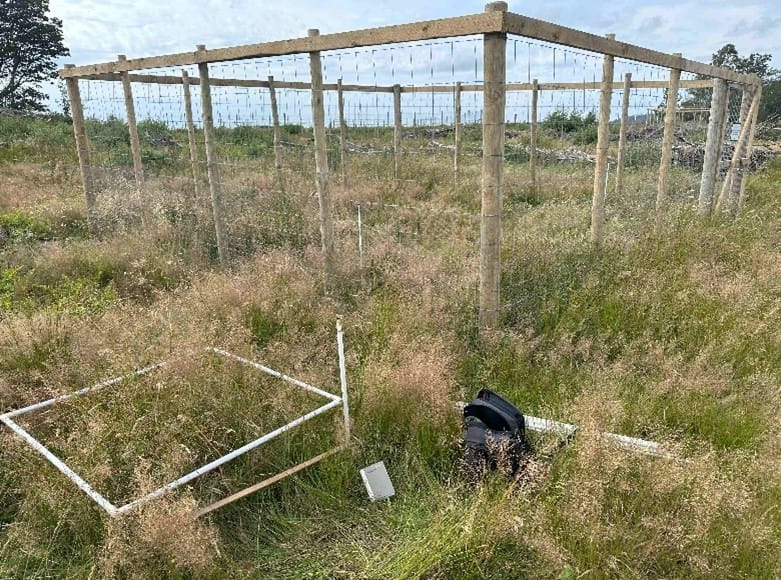
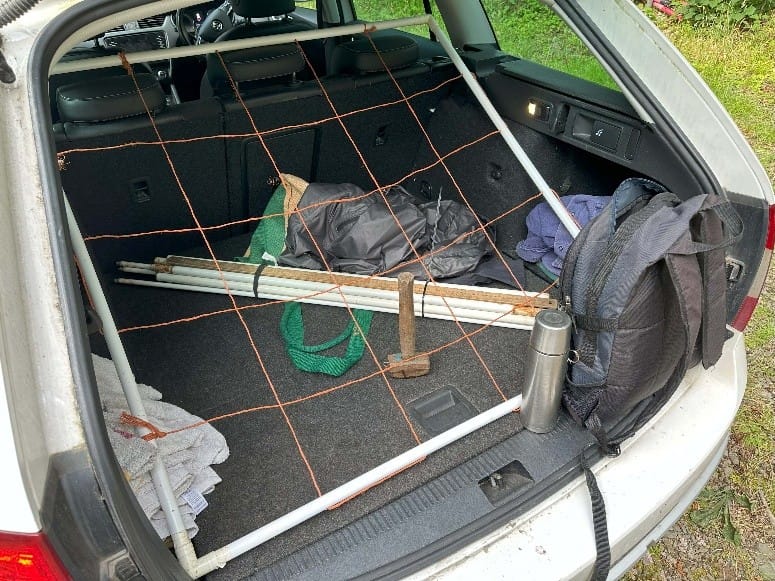
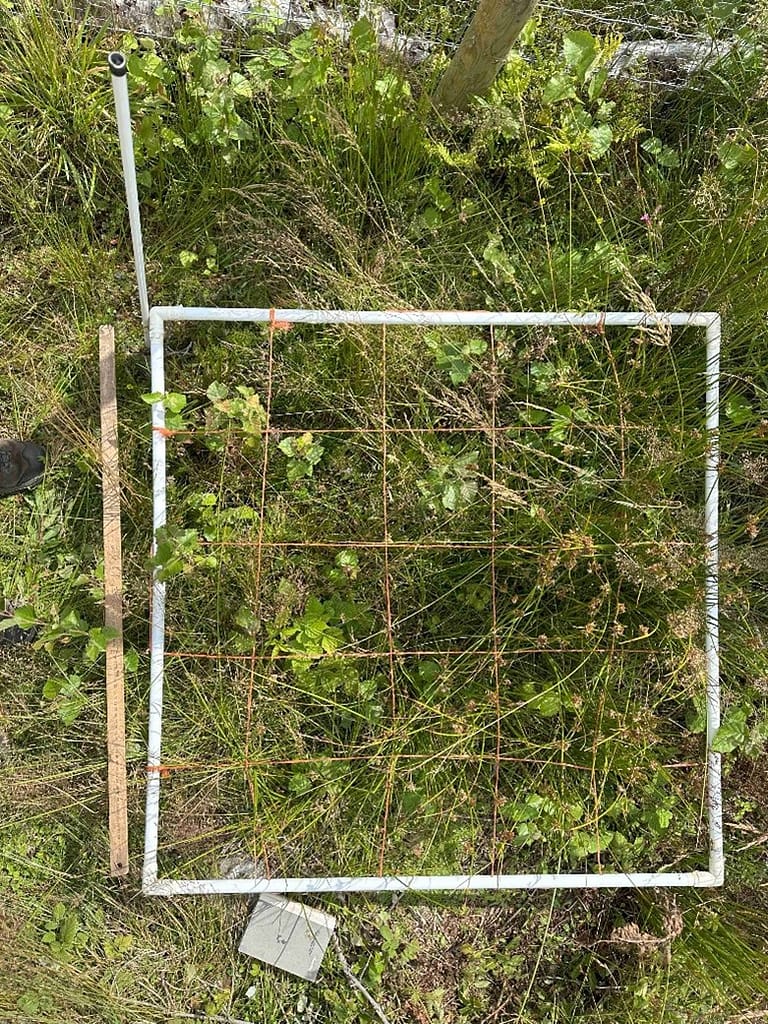
As part of trying to witness and measure that and to an extent understand it or at least refresh our deep memory and instinctual grasp of such things as animals ourselves, McNabb and co erected some “exclusion boxes” in the wood in March 2025, three in all, very well built with chicken wire and wooden frame sides and a door and quite a decent size at about 4m across. It was kind of an instinctual gut-felt response to do this on acquiring the wood, and I think it is great that they are there from the start as they can help tell a story. After our meeting I was drafted in to do some monitoring of these boxes and to establish some “control” plots – it is never going to be hardcore science but it is well worth having some comparison sites close by with which to compare as part of the story. The boxes will exclude any deer or rabbits (voles and mice will still have access to these open top havens where foxes and stoats cannot get them). Within the boxes and the control plots I have marked out some “permanent” 1m square quadrats where I measure plant species percentage cover, average vegetation height at regular intervals and as far as possible the height of any tree saplings present (99% birch) and try and score how many growing leader tips they appear to have – a somewhat subjective measure but that’s ecology! Basically, as the boxes are there to try and understand grazing pressure as the woodland develops, it seems logical to try and assess what grazing pressure there is, if any.
The data have not been processed yet but the initial impression was one of it being early days, i.e. there is a lot of bare ground in some of the boxes and in some of the “random” control plots. Basically, the starting conditions at the box sites chosen currently determine what is there and ecological processes have not yet likely had time to change that in any noticeable way.
As the surveys were conducted mid-August, with the previous dry conditions and approach of autumn, much of the material was senescing, but if the measuring process is continued over the next year or two then differences may become apparent and then reasons for any differences can be considered. Of course, what may well happen is that the vegetation communities within the boxes develop to be virtually identical to those outside the boxes which is kind of a win as it means species such as deer are not at damaging numbers and can be left to roam as they wish and nature can just be left to get on with the development of the site as it wishes…
Words + photos: Dr. Larry Griffin, September 2025.