To support the ‘Bennel Wood – Woodland Laboratory’ project, we’ll be posting a series of blogs as we learn more about natural regeneration and the influence different treatments have on what grows on (and lives in!) a recently felled commercial site.
The seventh blog is by DGW Trustee Ian Murgatroyd, giving a snapshot of recent work to understand what is growing at Bennel Wood, and what is not!…
Invader
At Bennel we have a woodland invader from the Iberian peninsula that has introgressed with an American species. It is a killer in full sight, with siege characteristics and resilience when challenged.
Rhododendren ponticum produces a dense shade with an acidic leaf litter that is high in polyphenols and low in nitrogen. As it spreads, it obliterates existing plant growth & inhibits natural regeneration.
The flowers and leaves contain the highest levels of grayanotoxin, a neurotoxin that is reported to cause the illness or death in animals and humans.
It is also a sporulating host of Phytopthora ramorum and a host to Phytopthora kernoviae, two devastating pests which kill a range of trees and plants.
We are taking the fight to this invasive killer. We are planning a five year campaign (more if required) matching our determination against the resilience of hybrid vigour. We will; uproot, cut by hand tools & chainsaw and where required, apply repeated herbicide to vigorous regrowth.
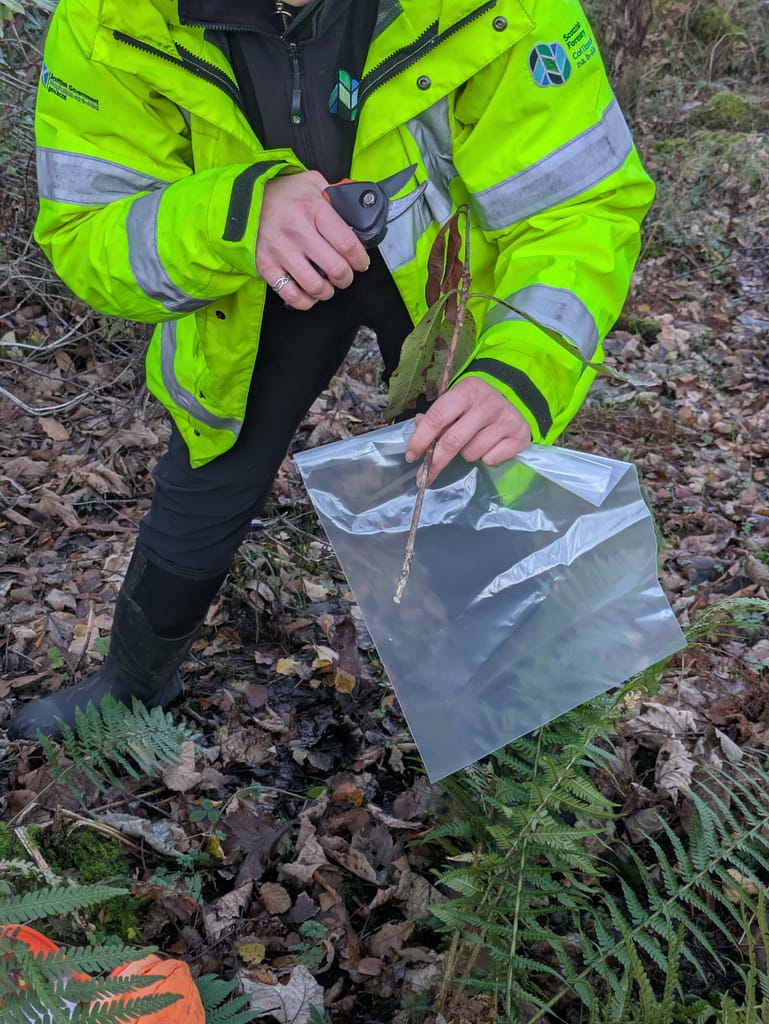
The fight has started with resolute volunteers. In year 1, we have targeted all sub waist height Rhododendron and have successfully tested our techniques on three mature clumps of Rhododendron. Team work and pacing are required for the long haul.
Regenerates
We are watching our natural regeneration (mostly from seed, some from coppice growth) using 13 permanent 1/100 hectare plots which have a central marker post to anchor our 5.64 metre radius plot. All trees are counted within each plot and we can then calculate the numbers of trees per hectare by species as a range and as an average.
The range of trees per hectare is about 200 to 14000 with an average density of about 4700 trees per hectare. Non native guests include spruce, fir and sycamore, pioneers include birch, grey willow and rowan and our A Listers are holly, hawthorn, elderflower and oak.
Competing growth from a range of plants (including raspberry, foxglove, rushes, bramble, ferns, rosebay willow herb, grasses) and grazing by woodland enthusiasts such as deer and weevils, are in an establishment race with conditions favouring regeneration from seed, diminishing as time passes.
Ian Murgatroyd, DGW Trustee, November 2025
