How can we better connect native woodland fragments, creating wildlife corridors and nature networks across Dumfries & Galloway?
Background
Work is underway on the Wood-Wide Network project, investigating options for ‘Woodland Connectivity’ across Dumfries & Galloway. This project is supported by a development grant from the Scottish Government’s Nature Restoration Fund, administered by NatureScot.
Throughout 2026, Dumfries & Galloway Woodlands is working to identify woodland connectivity work in the region, discussing the potential work with landowners and starting to pull together details of costings, constraints and work required. This will be compiled to form an ambitious multi-year delivery project, with a scheduled start of 2027.
Woodland Connectivity
‘Woodland connectivity’ is seen as one of the most appropriate ways to bring trees, and all the benefits they can bring, into a productive landscape. Dumfries & Galloway makes up 8% of Scotland’s land area, and is extraordinarily productive in terms of the agricultural sector and forestry sector. This project respects that, working with landowners to establish woodland connectivity, habitat resilience and nature networks.

This tailored and considered approach doesn’t reduce the other productive uses of the land, and can vary from a simple line of trees along a field boundary through to hedge lines, re-establishment of fragmented woodland areas and wood pasture tree planting, through to larger planting activity. Trees can bring a whole range of benefits to a working landscape – from shade and wind protection for livestock, through to the landscape impact of planting the next generation of native trees.
Proactive Approach
This is the first time that DGW has been able to proactively look at woodland corridors and the potential to connect fragmented or at-risk blocks of native woodland. This is made possible thanks to funding from NatureScot, but also support from the Solway Coast & Marine Landscape Connections Project (SCAMP) (https://www.solwaycoastmarine.co.uk/) which has allowed us to engage Scottish Association for Marine Science (‘SAMS’ – https://www.sams.ac.uk/). SAMS supported efforts to compile publicly available data layers such as ancient tree mapping and Native Woodland of Scotland maps, and to analyze these for potential ‘connectivity’ benefits.
Landowner Engagement
This project is obviously ultimately a landowner engagement/appetite task, and the NatureScot funding has allowed us to recruit three contractors for work between August and November 2026 to identify and scope ecological and deliverable and appropriate woodland corridor projects that align with landowner ambitions. We advertised the contracts as ‘WEST’, ‘CENTRAL’ and ‘EAST’ to give an approximate geographical focus.
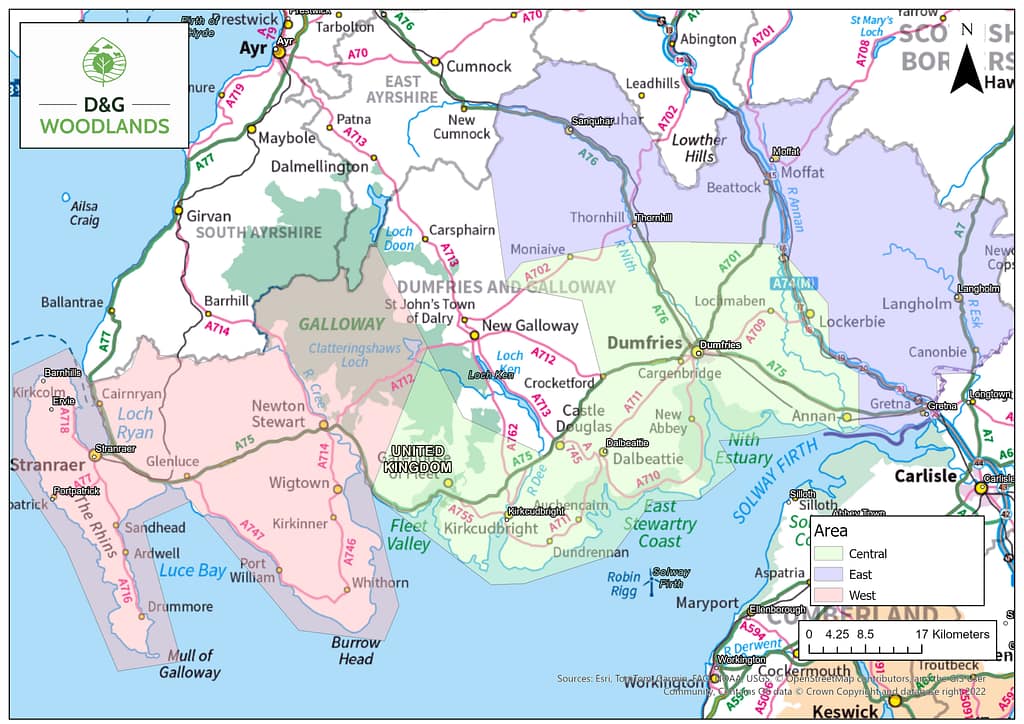
This project is entirely voluntary and relationship-based, with no statutory backing. Engagement in this development phase does not rule out the potential for partnership work in later years. Similarly, engagement now does not prevent a landowner from seeking alternative options subsequently.
(Note: we are working in partnership with the Glenkens Land and Livelihoods Initiative (https://glenkens.scot/projects/nature-restoration), with work underway by that project in the Glenkens, hence omission from above map for clarity purposes.)
Initial work has been incredibly positive, with a wide range of landowners engaged and willing to develop woodland connectivity work. It is already clear that there is appetite for an ambitious multi-year project that will compile small scale interventions into a regionally significant increase in woodland connectivity.
By December 2026, we will have areas of focus for creation of Nature Networks, landowner consent for early deliverables and a pipeline of subsequent work across the region.
Project Funding
Through 2026, the project is 85% funded by a Development grant through NatureScot’s Nature Restoration Fund. A contribution of £5,000 has been secured from the Solway Coast & Marine Project’s development phase towards the SAMS mapping support and the balance is funded from Dumfries & Galloway Woodlands’ own reserves.
DGW separately delivers the Dumfries & Galloway Tree Planting Grant Scheme, which can contribute support on a site-by-site basis, and DGW operates as an agent for the Woodland Trusts’ MOREWoods scheme. These can be useful for this project, however early feedback from contractors show that Nature Network establishment activity can include considerable other costs, including hedges, larger scale planting, fencing and staff time.
Work is now underway to pull together funding from a variety of sources for the delivery phase, with an ambition for a multi year project of activity across the region. Funding opportunities include areas such as Natural Capital Investment, alignment with Planning Gain objectives, private donations and regular funding applications.
The ambition is that from December 2026 onwards, DGW staff will compile appropriate, considered and landscape-appropriate woodland connectivity work into an ambitious multi-year project.
This will include exploration of funding models and methods to deliver an ambitious nature positive project, delivering wildlife corridors and nature networks across the region. Any queries, contact mcnabb.laurie@dgwoodlands.org.
Project Update:
- Project Blog – Getting Started – https://dgwoodlands.org.uk/wood-wide-network-project-update-blog/